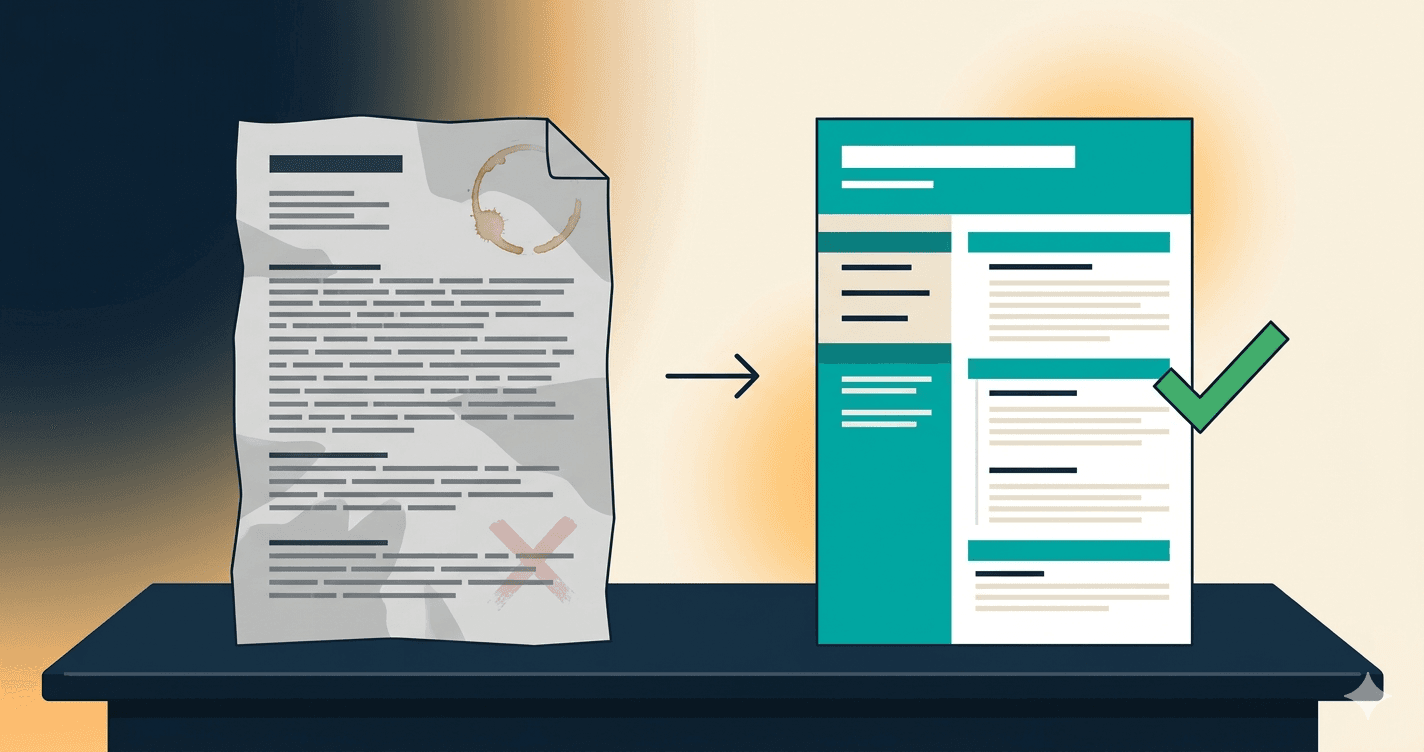
Here's the truth that most career coaches bury in euphemism: your nursing resume is written for a hospital recruiter, and corporate healthcare recruiters are not hospital recruiters.
When a Medtronic or Stryker or Abbott recruiter opens your resume and sees "Provided direct patient care for 6–8 ICU patients per shift including medication administration, wound care, and family communication": they feel nothing. Not because it's bad. Because they can't picture what it means for the job they're trying to fill.
That's the language problem. And until you fix it, you can apply to 100 corporate healthcare jobs and get 0 responses. Not because you're underqualified, but because your resume is speaking the wrong language.
This post shows you exactly how to fix it, with real before/after examples.
If you're still deciding whether to make the jump at all, start here first: Leaving Bedside Nursing: What Nobody Tells You About the Corporate Jump →
Why Clinical Language Kills Corporate Applications
Corporate healthcare recruiters are evaluating you on a completely different set of criteria than hospital nursing managers.
A hospital nursing manager reading your resume wants to know:
- Can you manage patient ratios safely?
- Do you know your specialty protocols?
- Are you licensed and certified?
A MedTech or pharma recruiter reading your resume wants to know:
- Can you influence a physician's behavior?
- Can you manage relationships across multiple accounts?
- Can you handle pressure and ambiguity without supervision?
- Can you learn fast and adapt?
- Can you communicate complex clinical information to non-clinical audiences?
These are different questions, and your current nursing resume only answers the first set.
Worse, it signals things that hurt you. Phrases like "provided direct patient care" and "administered medications per protocol" tell the corporate recruiter: this person is used to following orders, not driving outcomes. Even if you were the most autonomous nurse on your floor, your resume says otherwise.
The fix is not to lie or exaggerate. The fix is to frame what you actually did in language that maps to the competencies corporate employers care about.
The 5 Types of Language That Get Nurses Ignored
1. Patient count language
"Managed 6–8 patients per shift"
This says nothing to a corporate recruiter. They have no frame of reference for what that means in terms of your capability.
2. Task-based bullet points
"Administered IV medications and monitored for adverse reactions"
This is a description of a duty, not an outcome. Corporate resumes show impact.
3. Protocol-dependent framing
"Followed hospital protocols for infection control and documentation"
This signals compliance, not leadership.
4. Passive voice / vague ownership
"Assisted in the care of post-surgical patients"
"Assisted" suggests you were secondary. Were you the primary nurse? Then say so.
5. Clinical acronyms without context
"Managed patients on IABP, Impella, and CRRT"
To a nurse: impressive. To a corporate recruiter: gibberish they can't evaluate.
The Language That Actually Gets Corporate Attention
Corporate recruiters are scanning for a different set of signals entirely. Scale and scope: how many patients, how complex, over what time period. Numbers create context that clinical language never provides.
Influence and communication matter more than clinical skill on a corporate resume. Did you explain something to a physician and change their mind? Did you train anyone? That's a leadership signal, name it explicitly.
Outcomes, not duties. Not what you did, but what improved because of it. And cross-functional work: did you coordinate with pharmacy, administrators, surgical teams, families? Name the people. Corporate recruiters are picturing whether you can manage relationships across a territory, show them you already have.
The ICU nurse superpower is adaptability under pressure. Most nurses undersell this because it feels routine to them. It isn't routine to a corporate recruiter who has never worked a code.
Before / After: Real Nursing Resume Bullets
ICU Nurse → Clinical Specialist (MedTech)
BEFORE:
Provided bedside care for ICU patients on cardiac monitors, ventilators, and vasoactive drips. Assessed hemodynamic status and initiated interventions per physician orders.
AFTER:
Managed critical care for patients on complex device-dependent therapy (IABP, CRRT, mechanical ventilation), interpreting hemodynamic data and coordinating real-time interventions with cardiothoracic surgeons, intensivists, and perfusionists. Built deep fluency in device performance that now directly supports clinical training and sales.
CICU Nurse → Cardiac Device Clinical Specialist
BEFORE:
Cared for post-cardiac surgery patients. Educated patients and families on discharge instructions.
AFTER:
Delivered device-specific patient education across 400+ cardiac post-procedure encounters, adapting technical cardiac information (rhythm interpretation, pacing function, anticoagulation protocols) to patient comprehension levels. That communication skill transfers directly to clinical account management and HCP education.
ER Nurse → Pharma Sales Representative
BEFORE:
Worked in a high-volume emergency department. Triaged patients and administered medications. Collaborated with multidisciplinary team.
AFTER:
Managed 15–20 acute patient encounters per shift in a high-volume ED ranked in the top 10% by patient volume in the state, synthesizing clinical information rapidly and influencing physician decision-making on pharmacological interventions. Those relationship skills and clinical credibility translate directly to territory-based pharmaceutical sales.
NICU Nurse → Clinical Educator (Medical Devices)
BEFORE:
Precepted new nurses. Provided education on NICU protocols and equipment.
AFTER:
Designed and delivered clinical competency training for 30+ new nurses across NICU orientation programs, simplifying complex neonatal physiology and equipment operation (ventilators, warming systems, infusion pumps) for a variety of learning styles. Directly applicable to clinical education roles in MedTech.
OR Nurse → Territory Manager / Surgical Sales
BEFORE:
Scrubbed and circulated for orthopedic, cardiac, and general surgery cases. Maintained sterile field and managed surgical instruments.
AFTER:
Supported 500+ surgical procedures as scrub and circulator across orthopedic, cardiac, and laparoscopic specialties, building expert-level familiarity with surgical workflow, device usage patterns, and surgeon preference cards that provides a foundation for high-impact territory management in surgical sales.
Rewriting Your Summary Statement
Most nursing resumes open with something like:
"Dedicated Registered Nurse with 7 years of experience in ICU providing compassionate, high-quality patient care in fast-paced environments."
This is warm and harmless and completely useless for corporate applications.
Try this instead:
"ICU RN with 7 years managing high-acuity cardiac and respiratory patients, now transitioning to clinical specialist roles in MedTech. Deep device familiarity (IABP, CRRT, ventilators) combined with demonstrated ability to influence multidisciplinary clinical teams and educate patients under pressure. Seeking roles where clinical credibility drives commercial outcomes."
Notice what this does:
- Names the target (clinical specialist, MedTech)
- Names the devices (shows specificity)
- Translates the skill (influence, education, commercial outcomes)
- Signals direction (so recruiters don't have to guess)
The Section That Most Nurses Forget
Almost no nursing resume includes a Skills & Qualifications section tuned for corporate healthcare. Yours should include:
Clinical competencies relevant to your target role:
- Hemodynamic monitoring, cardiac rhythm interpretation
- OR/procedural suite protocols
- Device-specific training (name the devices)
Soft skills reframed as business skills:
- Territory management analog: "managed complex multi-patient caseloads across 12+ attending physicians"
- Relationship building: "primary patient advocate across all care team communication"
- Presentation skills: "delivered shift-change briefings to 20+ clinical staff"
Certifications that cross over:
CCRN, CEN, OCN, CNOR. These matter to corporate healthcare employers, especially in their specific sector. A CCRN applying to a cardiac device company is meaningful.
The LinkedIn Problem (It's Separate From the Resume)
A rewritten resume helps you get through ATS. LinkedIn is where recruiters proactively find you, and your LinkedIn profile is usually an afterthought.
Corporate healthcare recruiters search LinkedIn with terms like:
- "ICU nurse clinical specialist"
- "RN MedTech"
- "registered nurse Medtronic"
- "cardiac nurse device"
If your LinkedIn headline still says "Registered Nurse | ICU | [Hospital Name]", you're invisible to these searches.
Change your headline to something like:
"ICU RN → Clinical Specialist | Cardiac Device & MedTech | Open to Opportunities"
And your About section needs the same corporate language treatment your resume got. Recruiters who find you on LinkedIn read the About first. If it's written for a nursing manager, you're disqualifying yourself before they reach out.
Why Your Clinical Stories Are Already the Answer
Once you get the interview, and a rewritten resume does change those odds, you'll face behavioral questions that nursing interview prep doesn't cover:
- "Tell me about a time you influenced someone who wasn't a direct report."
- "Describe a time you had to learn a complex product or protocol quickly."
- "Give me an example of how you handled a difficult customer relationship."
Your clinical stories are perfect answers to these questions. You just need to translate them from "what happened in the hospital" to "what the corporate interviewer is actually hearing."
Example:
Clinical version of a story: "We had a patient whose surgeon wanted to do a procedure I thought was premature. I brought my concerns to the attending, we discussed the data, and we ultimately postponed and the patient did better."
STAR-translated version:
"In my ICU role, I identified a clinical situation where the proposed intervention conflicted with the patient's hemodynamic trajectory. I prepared a concise data summary and facilitated a direct conversation with the surgical team, presenting evidence that ultimately changed the care plan. The outcome was a patient who avoided a high-risk procedure and recovered without complication. This required both clinical confidence and the ability to communicate persuasively with senior physicians. Skills directly applicable to clinical account management."
Same story. Different framing. That's what STAR translation is.
How Long This Takes (If You Do It Yourself)
Be honest with yourself about the time investment:
- Rewriting your resume summary: 2–4 hours
- Rewriting 8–10 bullet points: 3–6 hours
- Writing STAR stories for interview prep: 4–8 hours
- Updating LinkedIn: 2–3 hours
That's 11–21 hours of work, assuming you know exactly what language to use, which is the hard part.
Most nurses who try to do this alone spend twice that time and still send something that sounds like a nursing resume with corporate words sprinkled in. The mistake is thinking about what you did rather than what value corporate employers are buying.
The Faster Path
If you want to skip the months of trial-and-error and get a corporate-ready resume based on your actual clinical background:
Start with the free quiz to identify your best-fit corporate roles (2 minutes). Then the Resume Transformer takes your current nursing resume and outputs it in corporate healthcare language, tuned for the specific role your quiz matched you with.
One-time. $49.99.
The nurses who get MedTech interviews aren't more qualified than the nurses who don't. They just figured out the language problem first.